

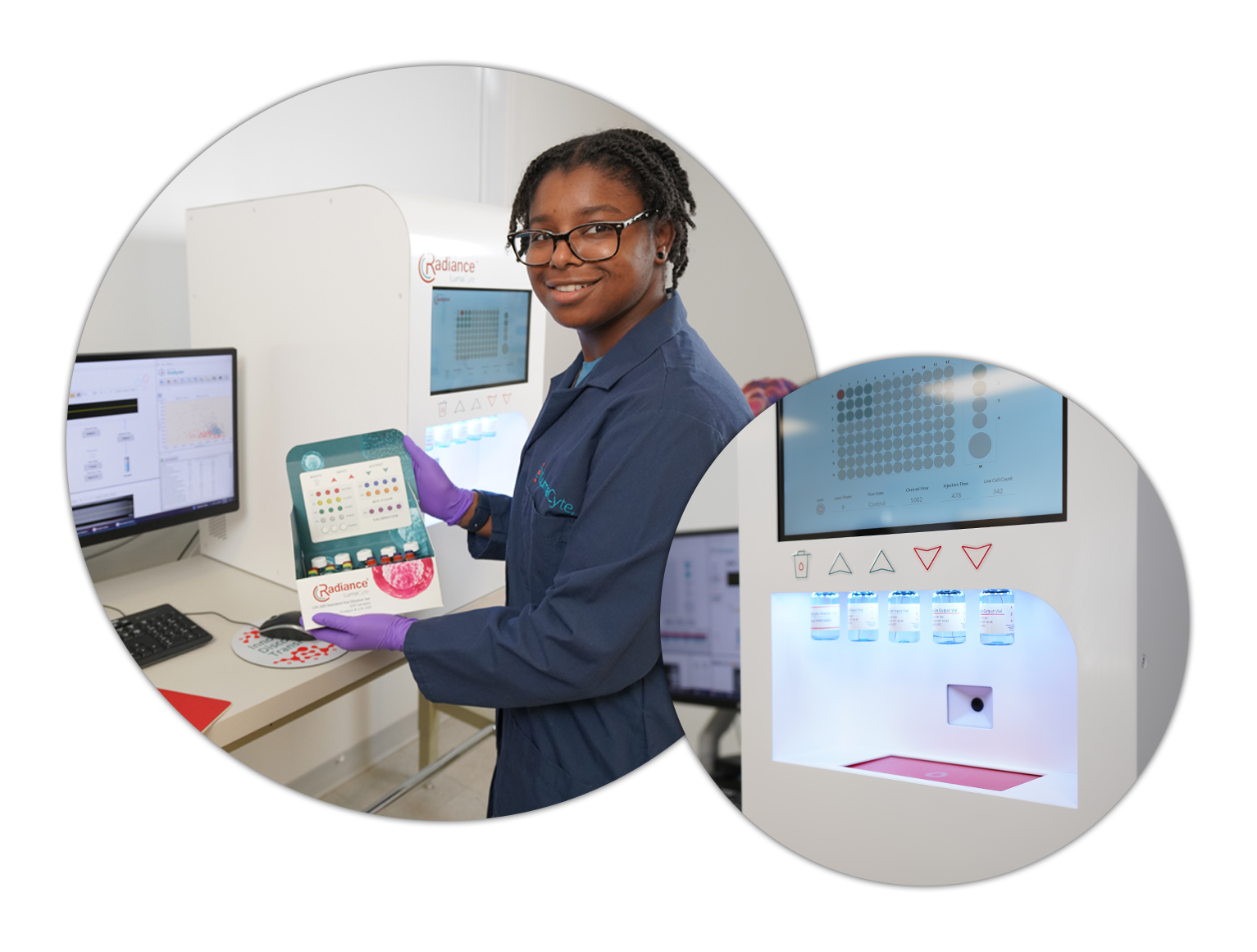
Laser Force Cytology™ (LFC™) measures real-time cellular biochemical and biophysical responses to applied laser optical forces within a microfluidic channel. Implemented on LumaCyte’s Radiance® instrument, LFC™ is designed as a platform cellular PAT that generates 20+ parameters per cell simultaneously, without labels, stains, or disruptions to the native cellular physiology. Each cell’s response reflects the balance between the optical force decelerating it and the hydrodynamic drag carrying it through the channel, with that force integrating refraction through every internal interface, organelle membranes, nuclear envelope, dense subcellular structures, so mitochondrial content, nuclear material, and nucleus-to-cell ratio all shape how strongly each cell interacts with the field. The technology is commercially available, incorporated into ISO 16921-2 (Gene Delivery – Quantification Methods for Viral Vectors) and ISO 8934-1 (Biotechnology – Cell Viability Analytical Methods), and tested across 50 cell types and 40+ viruses, many already in peer-reviewed publications. ATCC® independently uses LFC™ for adenovirus global reference standard Certificates of Analysis (CoA), establishing a reference-grade precedent.

Label-Free Multiparameter Cellular Analysis Powered by Laser Force Cytology™
Laser Force Cytology™ ISO-published methods provide customers with rapid, automated, single-cell analytics for the comprehensive characterization of cellular starting materials and potency throughout an ongoing process, delivering significant improvements in speed, precision, and quality.
The Challenge in Advanced Therapy Manufacturing
Manufacturing advanced biotherapies is difficult because starting materials vary widely, cellular behavior shifts rapidly, and most analytics are too slow or subjective to keep pace. These gaps create blind spots that contribute to delayed optimization, inconsistent potency, and preventable batch failures.
Laser Force Cytology™ overcomes these limitations with real‑time, label‑free single‑cell analysis that detects the earliest functional changes in cells. By measuring intrinsic properties at the single‑cell level, LFC™ provides rapid, quantitative, operator‑independent insight into cell quality, vitality, and potency throughout the process—empowering faster decisions, reduced variability, and more reliable scale‑up. Together, these capabilities reinforce robust regulatory assurance strategies and streamline development, reducing timelines and resource demands while accelerating patient access.
How Does Laser Force Cytology™ Work?
Laser Force Cytology measures how individual cells respond to precisely controlled optical and fluidic forces within a microfluidic environment. This captures dynamic behavior in real time with high precision. These interactions generate label-free biochemical and biophysical response signatures that are highly reproducible, as they reflect intrinsic cell properties rather than variability introduced by dyes, stains, or sample preparation.
Unlike conventional methods limited to labeled markers or static endpoints, LFC delivers consistent, quantitative single-cell response metrics that reveal functional state and heterogeneity not accessible through traditional assays.
Radiance® reveals the cellular responses that drive quality, consistency, and performance across advanced biologics.

Biomanufacturing process control: Real-time monitoring of cell vitality, activation, differentiation, and cytoskeletal remodeling to improve consistency, reduce variability, and strengthen batch comparability across advanced biologics.
Critical quality attribute (CQA) development: Quantitative, single-cell metrics linking functional potency, activation state, and cellular response to product quality, enabling more robust and defensible CMC strategies.
Process development and optimization: Rapid evaluation of transfection and transduction efficiency, media conditions, and process parameters based on true biochemical and cytoskeletal response, rather than proxy markers.
Raw material and input characterization: Ensuring starting materials are biologically robust and capable of driving successful manufacturing and potency outcomes.
This whole‑cell, label‑free approach captures the full spectrum of intrinsic cellular properties, enabling label‑free real‑time cell analysis with unmatched sensitivity and reproducibility.

A Few of the Many Factors Affecting Optical Force
Subtle phenotypic changes in cell biochemistry and morphology (cytoskeletal changes), which are often associated with cancer, sepsis, and other diseases, create measurable differences in optical force, deformability, and other multivariate parameters captured by Radiance®. When analyzed through univariate or multivariate machine learning models, these attributes support robust cell characterization, predictive functional assays, and advanced cellular PAT strategies.

Shape

Internal cellular structure
and organization

Surface morphology,
coatings

Refractive index (proteins,
cytoplasm, membrane)
Connecting Biology to Optical and Fluidic Forces
Laser Force Cytology™ (LFC™) links force-dependent cellular responses to the underlying biological processes that shape cell function and quality. As cells experience precisely applied optical and fluidic forces, Radiance® reveals how those forces translate into distinct, measurable biological responses—the same processes illustrated in the image below.
These intrinsic biochemical and biophysical signatures map directly to key transitions such as cell health monitoring (apoptosis), viral infection, and cell differentiation, each producing a characteristic force‑response profile that reflects underlying cellular state. By capturing these changes in real time and without labels, LFC™ provides a functional readout of how cells activate, remodel, or undergo stress‑driven change with exceptional sensitivity and reproducibility—making previously invisible biological dynamics directly measurable.

The Value of Label-Free LFC™ Analysis
Biomanufacturing requires fast, high‑resolution analytics to keep pace with dynamic cellular processes. Traditional assays are slow, subjective, and often unable to detect early functional changes. LFC™ delivers label‑free real‑time cell analysis and cellular PAT analytics that help teams optimize processes, improve product quality, and strengthen regulatory alignment.
Antibody Based Assay Limitations
Advantages of Label-Free Laser Force Cytology™
Real‑Time Detection of Subtle Cellular Changes
Subtle cellular changes are precisely captured with Radiance®, allowing developers to measure real‑time product quality attributes, rapidly optimize processes, and significantly improve production consistency, yields, and shelf life. By quantifying intrinsic biochemical and biophysical properties at the single‑cell level, Radiance® provides a sensitive, label‑free cell analysis readout that reveals early shifts in cell vitality, stress, activation, differentiation, and other functional performance metrics.
These real‑time insights support stronger cellular PAT strategies, enabling teams to identify deviations sooner, refine processes faster, and maintain tighter control over critical quality attributes—all without labels, dyes, or subjective interpretation.
Laser Force Cytology™ Compared to Current Analytics
LFC™ offers significant advantages over traditional analytical methods. Unlike assays that rely on antibodies or genetic labels, LFC™ combines label‑free single‑cell analysis with either univariate or the power of multivariate machine learning to detect subtle, early phenotypic changes at the single-cell level, often unresolved by flow cytometry or ELISA.

|
qPCR/ddPCR | Flow Cytometry | Viability | ELISA | TCID50 | |
| Data Quality | High | Medium | High | Low | Low | Low |
| Method of Detection | Cell-Based | Nucleic Acid | Cell-Based | Cell-Based | Protein | Cell-Based |
| Label/Reagent Free | ✓ | X | X | X | X | ✓ |
| Automation | ✓ | ✓ | X | ✓ | ✓ | X |
| Labor Requirements | Low | Medium | High | Low | Medium | High |
| Time to Result (TTR) | Low | Medium | Medium | Low | Medium | High |
| Cost Per Sample | Low | Low/Medium | High | Low | Medium | Medium |
| New Cellular Characterization | ✓ | X | X | X | X | X |
| Real-Time PAT | ✓ | X | X | ✓ | X | X |
Real-Time Cellular Process Analytical Technology (PAT) for Continuous Production Monitoring
Advanced bioanalytics are foundational to modern biomanufacturing because they deliver the early, actionable insight needed to control complex biological systems. In biopharmaceutical production, these tools allow teams to monitor and optimize critical parameters—cell culture conditions, protein expression, purification efficiency—with the precision required to maintain consistency and avoid costly deviations.
With Laser Force Cytology™, these capabilities expand into label‑free real‑time cell analysis and cellular PAT, giving developers a direct, quantitative view of how cells respond throughout the process. This means teams can detect subtle shifts in vitality, activation, or stress before they impact yield, quality, or comparability. The result is faster optimization, stronger control strategies, and fewer surprises late in development.
By providing a high‑resolution, whole‑cell readout of biological function, advanced bioanalytics help ensure that every step of the process is aligned with quality expectations and regulatory standards. Ultimately, these insights support the development of more reliable, higher‑quality biotherapeutics, reducing risk, accelerating timelines, and improving outcomes for the programs—and patients—they serve.
Laser Force Cytology™ Detects Cellular Changes Unresolved by Flow Cytometry
Below is a set of graphs comparing flow cytometry and LFC™ data of mouse RAW macrophages exposed to 5 µm silica beads. In the flow cytometry plots, the forward and side scatter of macrophages with and without silica beads completely overlap, making these differences undetectable.
Laser Force Cytology™ (LFC™) surpasses traditional flow cytometry by delivering high‑resolution, label‑free single‑cell analysis without fluorescent tagging, complex workflows, or lengthy prep—requiring just a 10‑minute sample preparation and a 5‑minute time‑to‑result. By measuring each cell’s intrinsic biochemical and biophysical properties in real time, LFC™ provides a deeper, more accurate view of cellular function and offers predictive insight into downstream behavior. This makes it ideal for applications demanding precision, minimal perturbation, and early functional foresight—capabilities conventional flow cytometry simply cannot match.

The LFC™ data delivers complete population separation with exceptional sensitivity—resolving macrophages based on subtle, bead‑by‑bead differences in silica uptake. Cells with higher bead uptake exhibit lower velocity and therefore higher optical force. This broadened distribution highlights the power of Laser Force Cytology™ to differentiate across a wide range of macrophage phagocytic activity, revealing subtle cellular changes that remain unresolved by flow cytometry. By measuring how cells behave rather than how they’re labeled, LFC™ exposes true biological function—unlocking insights that marker‑based assays simply cannot see.
Frequently Asked Questions
Is Laser Force Cytology destructive to the cells being analyzed?
No. Laser Force Cytology is non-destructive and label-free, meaning cells retain their native physiological state throughout measurement and are not consumed, fixed, or altered by dyes, antibodies, or genetic reporters. This makes it possible to preserve sample material for downstream use or additional testing where needed.
What cell types and sample formats are compatible with Laser Force Cytology?
Radiance has been validated across a wide range of mammalian cell types and formats, including suspension and adherent cultures, supporting applications from vaccine development to cell and gene therapy manufacturing. LumaCyte’s platform has been used across 40+ cell types and 45+ viruses to date, as outlined on the About LumaCyte page.
Is Laser Force Cytology aligned with any regulatory or ISO standards?
Yes. LFC-based measurements support standardized, high-confidence characterization aligned with global methods including ISO 16921-2 for viral vector titer and ISO 8934-1 for cell viability, helping teams build stronger regulatory narratives into their development and manufacturing programs.
How does Laser Force Cytology data integrate into existing lab or manufacturing software?
Radiance is powered by Illuminate software for instrument control and data acquisition, with ReportR available for automated, cloud-based reporting. Both are 21 CFR Part 11 compliant, allowing LFC data to fit directly into regulated development and QC workflows.
What is the difference between univariate and multivariate analysis of Laser Force Cytology data?
Univariate analysis evaluates a single cellular parameter at a time, while multivariate analysis combines the 20+ parameters captured per cell to build a more complete, predictive picture of cellular state. Explore how this is applied in practice on the Predictive Machine Learning Analytics page.
Ready to Advance Your Cell Analysis Capabilities?
Laser Force Cytology™ delivers the real‑time, label‑free single‑cell insight needed to strengthen process understanding, improve manufacturing consistency, and accelerate the path to commercial scale across advanced biotherapies. Whether you’re optimizing early research, refining process development, or implementing cellular PAT and advanced regulatory assurance strategies, Radiance® provides the clarity and confidence to move forward with reproducible precision—supporting more reliable therapies and faster access for the patients who depend on them.