
Developing More Precise, Efficient, and Reproducible AAV-Based Gene Therapies Using Laser Force Cytology™
Adeno‑Associated Virus (AAV) transduction is a foundational step in gene therapy, enabling the delivery of therapeutic genetic material into target cells with high efficiency and minimal immune response. Once inside the cell, the AAV vector delivers its transgene payload, driving expression of the desired gene. This mechanism underpins a wide range of applications—from treating genetic disorders and certain cancers to producing recombinant proteins and advancing clinical development and commercial manufacturing scale.
Yet despite its importance, precision in AAV transduction measurement remains one of the biggest challenges in gene therapy development. Traditional assays often rely on labels, reporters, or helper viruses, each introducing variability, delay, and biological perturbation that obscure true transduction performance. Because transduction efficiency directly influences viral vector yield and potency, having precise, real‑time analytics is essential for developing reliable AAV-based therapies.
As AAV programs advance toward clinical and commercial readiness, developers face a series of technical and analytical challenges that make precise measurement more important than ever.
Key Challenges in AAV Transduction
Teams developing AAV-based therapies continue to face persistent obstacles, including:

Optimizing transduction efficiency across diverse cell types
Managing cellular heterogeneity to ensure consistent outcomes
Tracking time‑dependent dynamics in transgene expression
Navigating immune responses such as neutralizing antibody formation
Together, these challenges make it difficult to confidently optimize AAV programs without more advanced analytical tools. They all point to the same underlying need: more precise, real‑time, and biologically relevant analytics.
Speak To An Expert
Precision-Driven AAV Transduction Analytics with Laser Force Cytology™
Laser Force Cytology™ (LFC) directly addresses the precision gap by providing real‑time, label‑free, helper‑virus‑free measurement of AAV transduction. Instead of relying on fluorescent reporters or waiting for downstream gene expression, LFC™ detects intrinsic biochemical and biophysical changes in the cell as transduction occurs. For in‑process cell infection monitoring, Radiance® is 800 to 3,000 times faster than traditional methods, turning what once took days into insights available in minutes. This speed enables rapid optimization, allowing teams to test more conditions in a single day than traditional assays could support in a week, or even a month when further compounded by the backlog of analytical development labs.
LumaCyte’s Radiance® delivers:
- True biological precision without labels or reporters
- Immediate insights into transduction efficiency and dynamics
- High‑resolution detection of cellular heterogeneity
- Consistent, reproducible measurements across experiments and cell types
By eliminating labels, dyes, and helper viruses, Radiance® removes major sources of assay variability—giving teams a clearer, more accurate picture of AAV constructs and performance.
Radiance®: Precision Without Helper Viruses or Labels
LumaCyte’s Radiance® instrument brings the power of LFC™ directly to the bench, enabling precise, quantitative measurement of AAV‑transduced cells without relying on:
- Helper viruses
- Labels and dyes
- Reporter constructs
- Extensive sample preparation
- Long assay turnaround times
This not only accelerates development timelines but also improves the quality, consistency, and reproducibility of key production processes. With Radiance®, teams can rapidly compare transduction conditions, optimize MOI and reagent ratios, and make informed decisions in real time—long before traditional assays would deliver results. LumaCyte’s technology also supports upstream AAV transfection workflows, providing the same real‑time, label‑free precision for evaluating transfection efficiency before viral production.
Speak To A Laser Force Cytology Expert
Analytics Across Multiple AAV Serotypes: Real-Time Precision Backed by Industry Data
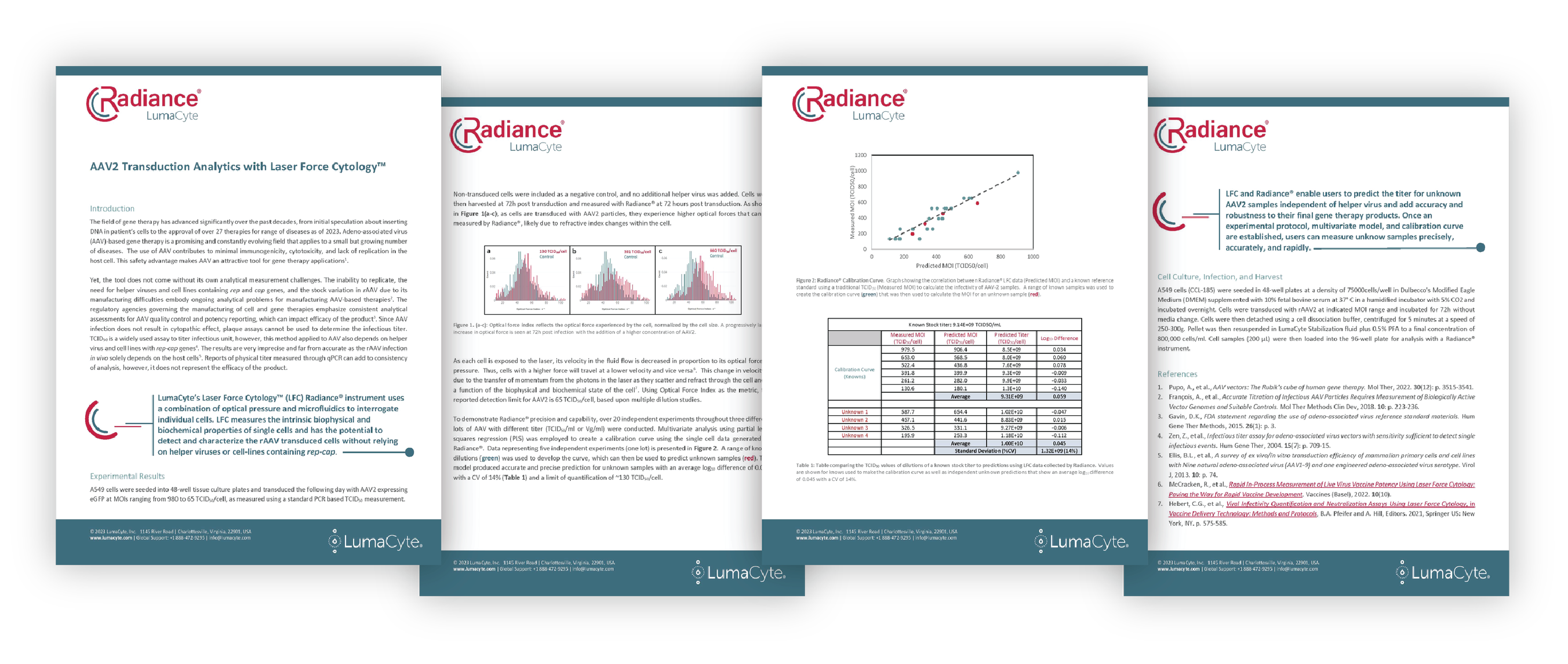
Radiance® supports analytics across multiple AAV serotypes—including AAV2, AAV5, AAV8, and AAV9—providing a consistent, label‑free platform for diverse vector programs. AAV2 remains one of the most widely used serotypes in gene therapy, and having precise, real‑time analytics is essential for optimizing its performance. Radiance® delivers a level of accuracy that traditional assays simply can’t match, offering label‑free, helper‑virus‑free measurement of AAV2 transduction dynamics directly at the single‑cell level. This allows teams to see true biological response in real time, without waiting for reporter expression or relying on indirect surrogate markers. Radiance® and the incorporation of advanced precision analytics accelerates the production of life saving gene therapy products and improves the quality and consistency of key production processes.
Explore the full AAV2 analytics study in our technical note to see how real‑time, label‑free measurements can transform your development workflow. To request additional data of other AAV serotypes, contact us today.
Why Precision Matters More Than Ever
In AAV development, small variations in transduction efficiency can cascade into major differences in yield, potency, and clinical performance. Precision is no longer a “nice to have”—it is essential for:
- Confident process optimization
- Reliable scale‑up
- Regulatory alignment
- Consistent therapeutic outcomes and patient safety
Radiance® provides the level of precision needed to meet these demands, helping developers move faster while still maintaining the highest standards of quality. That same precision is essential across other regulated biologics, including vaccines, where accurate viral measurement underpins potency, consistency, and patient safety. Reliable transduction analytics also form the foundation of potency assay development—a critical requirement for regulatory approval and a key driver of successful clinical and commercial outcomes.
How will you Harness the Power of Laser Force Cytology™?
Radiance® empowers gene therapy teams to accelerate development, improve reproducibility, and deliver higher‑quality AAV products—without the delays, variability, or complexity of traditional assays.
How will you use precision‑driven analytics to advance the next generation of life‑saving therapies?