

Predictive Cell Bank Qualification for Reliable Viral Vector Production
Every successful AAV therapy begins with a robust cell bank qualification strategy. Strong, viable cells are the foundation for consistent viral yields, and managing cell banks effectively is critical to ensuring quality outcomes. Traditional viability assays only confirm whether cells are alive at a single point in time—alive today but potentially non‑viable tomorrow.
Radiance® takes cell bank qualification a step further by measuring forward‑looking vitality, giving you a clear picture of whether your production cells are strong enough to sustain high yields over time. When you start with healthier, more resilient cells, you naturally set yourself up for better viral vector output. This predictive insight helps reduce batch‑failure risk, keeps viral potency consistent across runs, and makes the entire process more reliable. By focusing on robust cell bank differentiation from the start, manufacturers gain confidence in their starting material and protect the quality of downstream vaccine and gene therapy production.
By placing emphasis on robust cell bank qualification, manufacturers build confidence in their starting material and protect downstream AAV vector quality, scalability, and yields. Predictive cell vitality remains fundamental to any cell‑based production workflow, ensuring that cell banks and cellular starting material are set up for success long before transfection begins. This same principle applies across advanced modalities—from CAR T manufacturing, to stem cell–based therapies, to vaccine potency assays—where sustained cell strength directly influences process reliability and final product yield. No matter the platform, strong, well‑qualified cells are the foundation for consistent performance and successful therapy development.
Speak To An Expert
Real-Time, Label-Free Transfection Monitoring
Once a qualified cell bank is in place, the next step is making sure those cells perform well during transfection—because strong transfection performance is essential for reliable AAV vector production. Bringing real‑time, label‑free transfection monitoring into the process early helps manufacturers choose the right reagents and culture conditions while staying aligned with FDA and EMA expectations for potency and transfection efficiency assays. Taking this proactive approach strengthens process control, supports consistent viral vector quality, and creates a more reliable path from early development through scale‑up and commercial manufacturing.
Radiance® Laser Force Cytology™ makes this even easier by delivering real‑time, label‑free transfection insights that speed up process development and help maintain high yields. Unlike traditional methods such as flow cytometry, ELISA, or ddPCR—which require significant sample prep and long turnaround times—Radiance® provides immediate, actionable data right at the bench, giving teams the clarity they need without the wait.
Five Key Benefits of Radiance® in Transfection Monitoring
1. Real‑time, label‑free potency insights: Get immediate infectivity and potency readouts without waiting days for ELISA, ddPCR, or flow cytometry.
2. Faster, more confident decision‑making at the bench: Eliminates reliance on analytical development queues, allowing scientists to adjust conditions in the moment.
3. Streamlined workflows with no sample prep: Direct, at‑the‑bench measurements reduce hands‑on time, complexity, and risk of error.
4. Accelerated process optimization: Quickly evaluate reagents, MOIs, and conditions to improve yield, consistency, and scalability.
5. Rapid transfectant and reagent selection: A bench‑top instrument that enables fast comparison of transfection reagents and conditions, shortening development cycles.
Together, these benefits allow manufacturers to optimize processes quickly, reduce risk, and improve accuracy of titer and quality of yields.
Real-Time Label-Free AAV Transfection Monitoring in HEK293 Cells
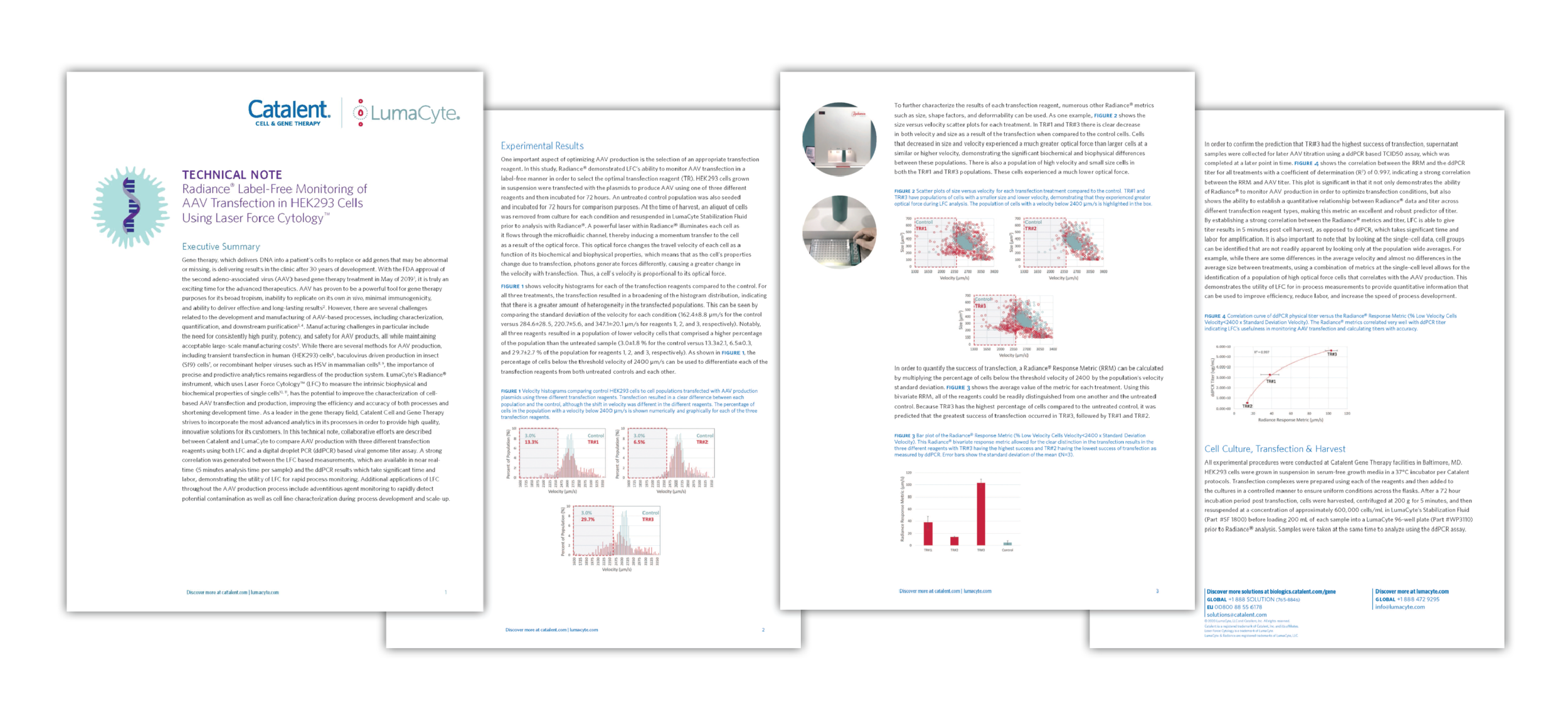
In a joint study, Catalent and LumaCyte evaluated AAV production across three transfection reagents using both Laser Force Cytology™ (LFC™) and a digital droplet PCR (ddPCR) viral genome titer assay. Radiance® delivered real‑time, label‑free measurements that strongly correlated with the slower ddPCR results—demonstrating its power as a rapid, predictive process monitoring tool. For in‑process infection assessment, Radiance® generated results 800 to 3,000 times faster than traditional methods.
With minimal sample preparation and time‑to‑result measured in minutes, Radiance® provides immediate insight into transfection efficiency, enabling faster optimization and more consistent, high‑quality process development. Its seamless fit within Process Analytical Technology (PAT) frameworks supports continuous monitoring and real‑time decision‑making throughout AAV manufacturing.
Together, these predictive, real‑time capabilities enhance process control, align with regulatory expectations for modern biologics production, and accelerate the development of life‑changing gene therapies.
Adventitious Agent Detection
Beyond transfection monitoring, Radiance® supports broader applications across AAV production. LFC™ enables rapid adventitious agent detection, allowing early identification of contamination and strengthening overall process control. Integrated within PAT frameworks, Radiance® provides continuous monitoring and early intervention to maintain manufacturing integrity.
Harness Radiance® to Accelerate AAV Therapy Development
Radiance® transforms AAV development by delivering real‑time, label‑free insights from predictive cell bank qualification through transfection and early production. With speed, precision, and built‑in predictive analytics, Radiance® reduces risk, streamlines workflows, and drives more consistent viral vector yields—empowering manufacturers to accelerate both development and scale‑up of advanced gene therapies.
Radiance® is also a trusted tool in adenovirus reference material manufacturing. Its rapid, label‑free viral titer measurement is included in the ATCC Adenovirus Reference Material Certificate of Analysis (CoA), underscoring its reliability as a standardized assay for precise viral quantification. This validation highlights Radiance®’s ability to deliver fast, reproducible titer data that supports regulatory expectations and strengthens confidence in adenovirus‑based processes. By enabling rapid, accurate viral titer assessment, Radiance® ensures that critical reference materials are produced with the precision and consistency required for a robust quality control strategy.